Your AI Team
Is Missing
One Person.
Every AI project stalled in legal review, every board question no one can answer, every compliance flag that stops a launch — it traces back to one gap: no one in the room owns governance.
We navigate that terrain. You ship the AI.
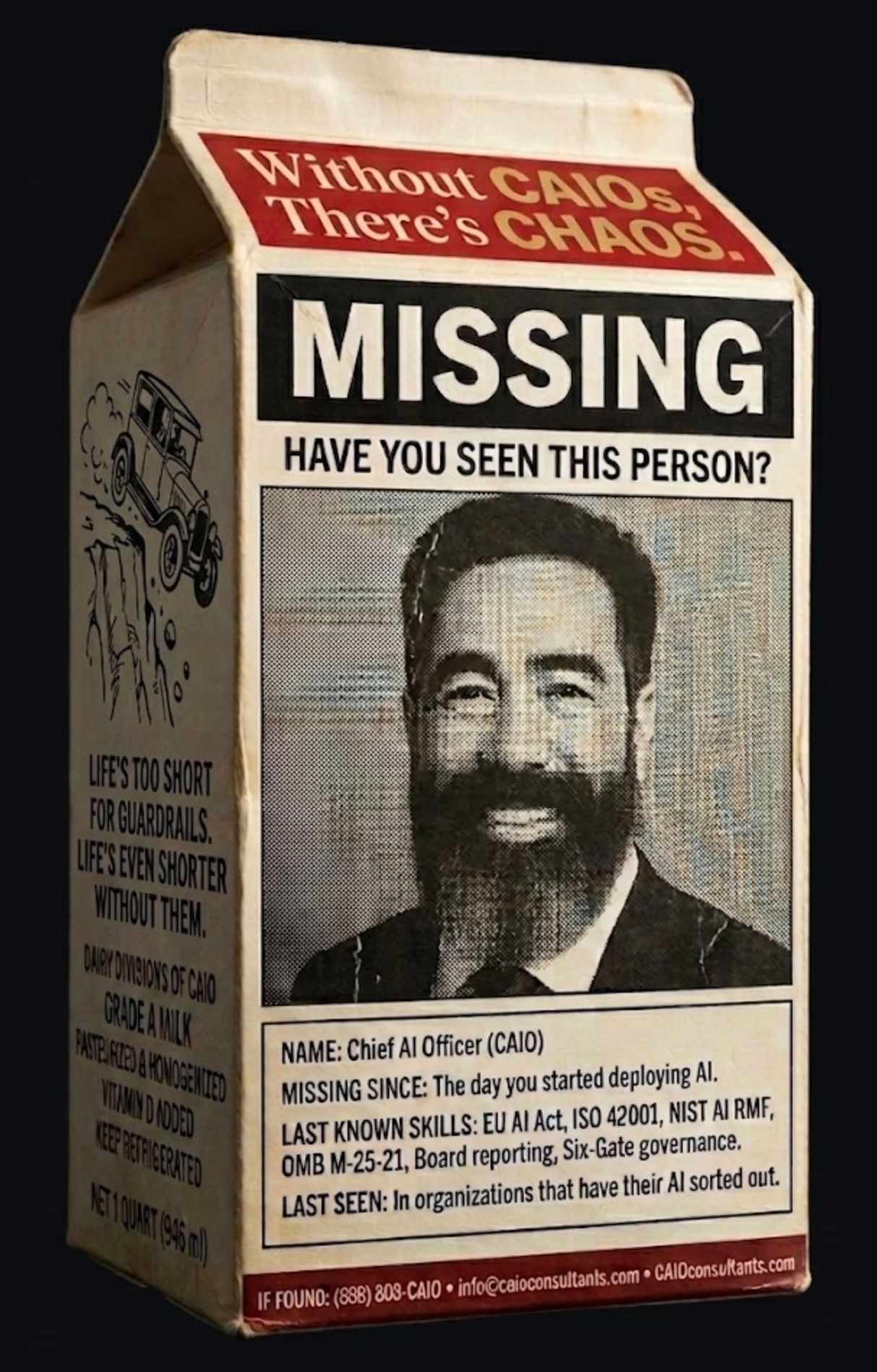
Strategic AI leadership isn’t optional anymore.
It’s what separates teams that ship from teams that sink.
“An ounce of prevention is worth a pound of cure.”— Benjamin Franklin
AI incidents rarely happen because of bad intentions. They happen because governance wasn’t in place before deployment was. A CAIO’s job is to close that gap—before it becomes a headline.
The Six-Gate
Governance Workflow.
No AI system ships without passing every gate. Not a checklist — a structured accountability chain with evidence captured at each step.
Use case mapped. Risk tier assigned. Policy conflicts identified before development begins.
Fairness, transparency, and privacy requirements built into design. Safety layers specified.
Model Cards and Lineage Diagrams auto-generated. CI/CD bias audit enforced. Evidence Vault updated.
Adversarial testing. Kill-switch verification. Algorithmic Impact Assessment signed. Vault locked.
AI Governance Council approval required. Legal and compliance sign-off. Nothing ships without this gate.
Live monitoring. Drift alerts. Bias-delta tracking. Quarterly audits auto-generated from the Evidence Vault.
“One Owner. One Number.” — One person your board can call. Your CAIO owns the mandate.
We Know the
Terrain.
Every framework below has specific documentation, oversight, and audit requirements. We navigate all of them.
World’s first comprehensive AI regulation. Risk-tiered system covering unacceptable, high, limited, and minimal risk AI. High-risk systems require conformity assessments, human oversight documentation, and transparency records. Max fine: €35M or 7% global revenue.
Enforcement 2025–26AI Management System standard — the ISO 9001 equivalent for AI. Auditors check for: documented AI policy and scope, risk assessment records, monitoring and measurement processes, management review evidence, and a corrective action process.
CertifiableVoluntary but increasingly required in government procurement. Four core functions: Govern (policies, culture), Map (context, risk identification), Measure (analysis, testing), Manage (response, recovery). Aligns with ISO 42001 and EU AI Act requirements.
Procurement RequirementFederal AI governance memorandum requiring agencies and covered contractors to appoint a Chief AI Officer, maintain AI use case inventories, and implement risk management policies. Affects any organization with federal contracts or AI-enabled government services.
New 2025HIPAA applied to AI systems handling protected health information. AI-driven clinical decision support, patient matching, and diagnostic tools face specific documentation, audit trail, and human oversight requirements. Annual penalty maximum: $1.9M per violation category.
Regulated SectorGoverns automated individual decision-making. AI systems making significant decisions about EU data subjects require human oversight options, explainability, and right-to-contest mechanisms. Applies regardless of where your company is incorporated.
ExtraterritorialSaudi Data and AI Authority ethics principles and UAE national AI Charter govern AI deployment across the Gulf. Required for government AI in both jurisdictions; increasingly expected in regulated private sector. Distinct from EU frameworks in approach to data sovereignty.
MENA RegionFinancial services regulators (SEC, FINRA) require AI governance for trading, advice, and risk systems. FDA Software as a Medical Device guidance governs AI in clinical settings. Each has specific audit trail, transparency, and human oversight requirements beyond general AI frameworks.
Sector-SpecificMost clients start with the AI Readiness Assessment. Others just reach out. Either works!
Three Ways to Start.
Every organization is at a different point. Most start with the Assessment. Some go straight to embedded governance. A few are ready to make it permanent.
You suspect there’s a governance gap but don’t know how big it is or where to start. This is the diagnostic. Five-pillar AIRAS framework, EU AI Act risk classification, ISO 42001 conformance baseline, and a prioritized 90-day roadmap. Fixed fee. No obligation to continue.
Start the Assessment →A certified CAIO embedded in your team. Deploys the Six-Gate workflow. Navigates regulatory requirements. Handles legal and board questions. Available in days... and if you’re ready for a permanent hire, we’ve got you covered.
Talk to a CAIO →Governance is working. You want it permanent. We identify and place a world-class Chief AI Officer — with governance benchmarks already established in your organization so the hire starts from a running program, not a blank page.
Start the Conversation →What People
Actually Ask.
What does a fractional Chief AI Officer actually do?
Day to day: a CAIO deploys governance frameworks, maps regulatory exposure, builds the documentation legal needs to sign off, prepares board-level AI risk reporting, and maintains accountability for every AI system your organization runs. The difference from a consultant: they stay. When the regulator asks questions six months after launch, your CAIO is still in the room.
What is EU AI Act compliance and does it apply to us?
The EU AI Act is the world’s first comprehensive AI regulation. High-risk AI systems require human oversight documentation, bias testing records, transparency documentation, and conformity assessments. Published maximum fine: €35M or 7% of global annual revenue. Compliance timelines are active. If you have EU customers or users, this is not a future problem.
What is OMB M-25-21 and does it affect private companies?
OMB Memorandum M-25-21 (2025) requires US federal agencies to appoint Chief AI Officers, maintain AI use case inventories, and implement risk management frameworks. Companies providing AI-enabled products or services to government are directly affected. We’ve seen M-25-21 compliance start appearing in federal RFPs in 2025. If you do government work, this is not optional.
Do we need ISO 42001 certification?
ISO 42001 is the AI equivalent of ISO 9001. An auditor will check for: documented AI policy and scope, risk assessment records, monitoring processes, management review evidence, and a corrective action process. Even without formal certification, building to ISO 42001 standards produces governance infrastructure that satisfies legal, investors, and enterprise procurement teams who require it. We can take you there.
How quickly can an engagement start?
A full-time CAIO search takes four to six months. A fractional engagement can begin within days of a signed agreement. The Assessment starts immediately. When legal has flagged something, a board presentation is two weeks out, or M-25-21 compliance just showed up in an RFP — four months from now is not an option.